
Engineering firms’ external attack surface management is the ongoing identification, review and verification of internet-facing assets with the aim of keeping security decisions tied to known systems and accountable owners. For MSPs serving architecture and engineering practices, the work starts by confirming which domains, project portals and externally hosted services belong in scope, rather than assuming every related hostname belongs to the firm.
- External attack surface management for engineering firms starts with confirmed ownership, dated observations and permission boundaries.
- SCOUTz is best for MSPs preparing evidence-led domain and Microsoft 365 sales conversations.
- Public-domain evidence cannot establish tenant permissions, internal sharing settings or a confirmed breach.
- Pair external discovery with authorized testing and rescans; preserve unknown evidence as unknown.
Why external attack surface management matters for engineering firms
An engineering firm’s name on a portal does not establish who administers it. Start your 2026 review by asking whether the firm, its MSP, a project partner or a software provider controls each service.
That distinction changes the next move. A DNS observation belongs with the domain administrator; a question about a hosted project application needs the application owner and the relevant provider. Neither observation establishes that project information has been exposed.
For an MSP, useful evidence supports a decision: confirm ownership, authorize a deeper review, correct a configuration or accept a documented condition. A finding becomes useful when someone can identify its boundary and choose an action. Apply the same discipline when you validate security assessment findings before a call.
This guide separates external observations from customer-authorized internal evidence. It also shows how to turn the review into an agreed scope without presenting a domain scan as a complete assessment.
Build an evidence-led review
Confirm asset ownership and authority
Start manually with a shared inventory. Ask the firm’s administrator to identify its primary domain, additional domains, public services and any project-specific systems that need review.
Record the difference between ownership and use. A firm can use a client’s document portal without controlling its security settings. A hostname containing the firm’s name is a research lead until someone confirms the relationship.
Keep public observation separate from active probing. Document authorization before testing services, and obtain legal advice where the proposed activity or jurisdiction requires it. A publicly reachable service does not grant unrestricted testing permission.
- Record each domain, hostname and service separately.
- Identify the business owner and technical administrator.
- Mark third-party and project-partner systems explicitly.
- Document permitted methods and excluded assets.
- Keep unconfirmed ownership in a research queue.
Capture a dated public baseline
Use DNS lookups, certificate inspection and permitted public observations to establish what is visible. Save the returned evidence rather than copying only a score or interpretation.
For email security, distinguish SPF, DKIM and DMARC. A published DMARC policy requesting monitoring does not establish compromise. Ask whether the policy is intentional, who reviews reporting and what must be validated before enforcement changes.
Maintain 1 pinned baseline per approved review scope. That baseline gives the later rescan a defined comparison point; it does not prove that every relevant asset has been discovered.
- Attach the check name, source and run date.
- Preserve the affected domain or hostname.
- Record the observed condition separately from its implication.
- Mark collection failures and incomplete coverage.
- Retain enough evidence for a practitioner to reproduce the observation.
Separate external observations from tenant evidence
A spreadsheet can maintain 2 evidence lanes: public-domain observations and customer-authorized internal evidence. Keep them separate throughout collection, interpretation and reporting.
SCOUTz provides cybersecurity prospect intelligence for MSPs through dated domain and Microsoft 365 reviews. Its domain evidence supports meeting preparation; it does not establish Conditional Access coverage, application permissions, license assignments, Intune device state or tenant sharing configuration.
The client’s October 15, 2026 product reference identifies Microsoft 365 Review as Open Beta. That review uses customer-authorized, read-only configuration and metadata access, without reading mail, files, chats, documents or prompts. Review activity makes no automatic configuration changes.
SCOUTz prepares the conversation. The relationship and the sale stay yours.
- Label each finding with its evidence lane.
- Obtain consent before collecting tenant evidence.
- State permission and license limitations.
- Place declared non-reads under NOT ASSESSED THIS SCAN.
- Keep external and tenant assessments out of a combined score.
Translate observations into owner decisions
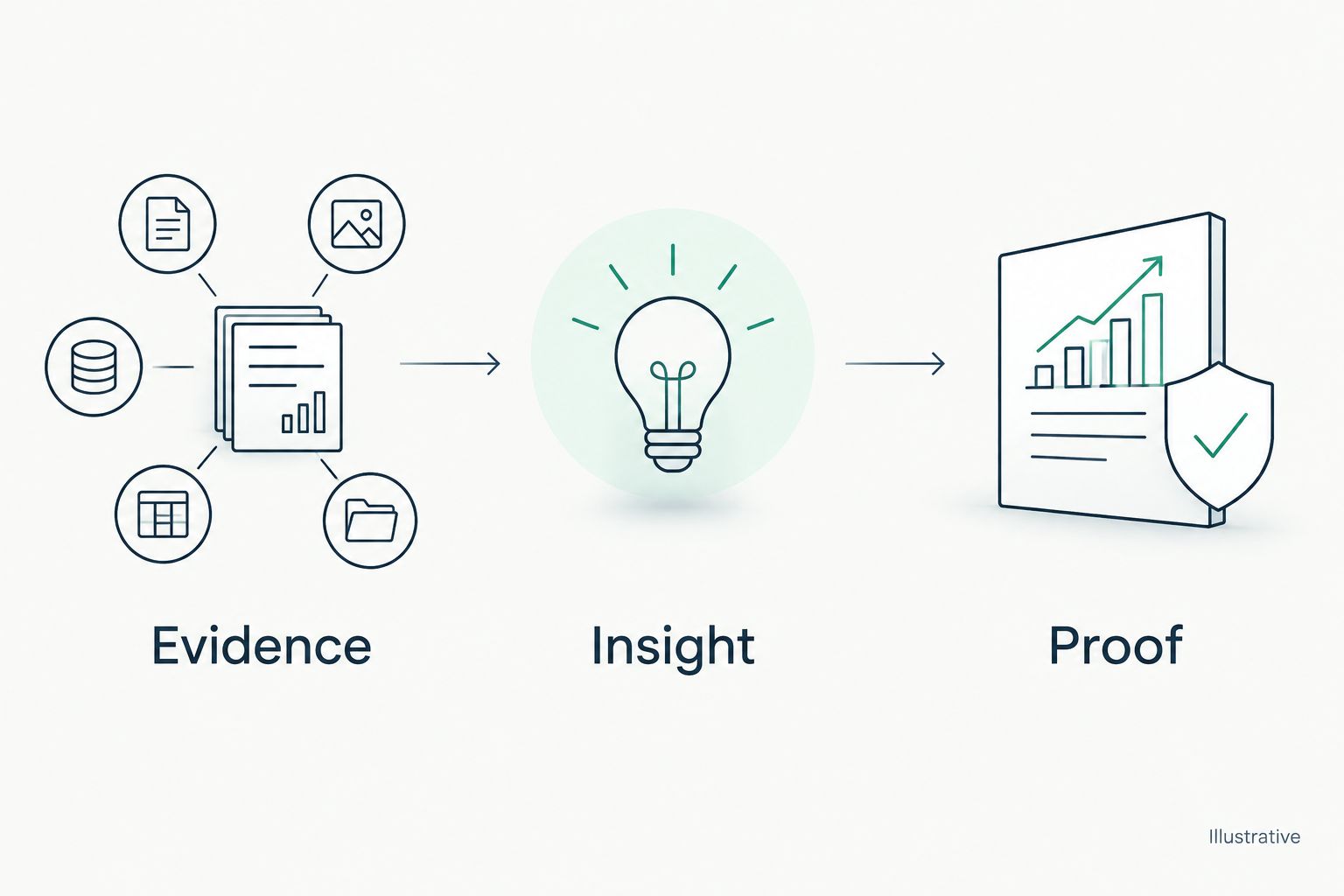
Use Evidence, Insight and Proof as distinct parts of the review. Evidence states what ran and what it returned. Insight explains the decision the observation supports. Proof compares a later observation against the pinned baseline.
For an engineering prospect, connect the question to a confirmed workflow. If the firm confirms that a domain sends project correspondence, ask who owns sender authorization and reporting. Do not assume which applications send that correspondence.
In your 2026 report, keep condition, affected object, unknowns and recommended outcome separate from vendor selection. The MSP and client can then choose a product, process, service, project or no change.
- State the observed condition without escalation.
- Name the affected object and evidence date.
- Explain the possible consequence within the evidence boundary.
- Identify the person who can confirm intent.
- Offer a specific next choice.
Agree on the decision before proposing work
Use the SCOUTz Evidence-to-Agreement Framework: Find the decision, Bring the evidence, Build the scope, Earn the next commitment. This is a conversation framework, not a proven close-rate intervention.
Start with the decision the buyer can make. For a monitoring-only DMARC observation, the first commitment can be an authorized sender review rather than immediate enforcement. Establish who must participate and what information the MSP needs.
The following is illustrative dialogue, not a customer transcript:
MSP: The dated DNS result shows a monitoring-only policy. It does not show whether that policy matches your intended setup. Who owns the sender inventory and reporting?
Prospect: Our existing provider handles that.
MSP: Then include that provider in the review. We can compare the current policy with the intended outcome before proposing a change.
- Find the decision and its owner.
- Bring the dated observation and its limits.
- Build a scope around the unanswered question.
- Include the existing provider when relevant.
- Record the next commitment without implying agreement to buy.
Define remediation and verification separately
Write the proposed outcome before naming a tool. For example, an email-security scope can cover sender identification, policy review, approved changes and verification. It should also identify what remains outside the engagement.
Do not promise that an external scan validates an internal control. A successful public recheck confirms the specific external condition tested. It cannot establish mailbox access history, device security or the health of a backup process.
Set a verification date with the owner rather than inventing a universal rescan interval. Recheck after an approved change and account for dependencies such as DNS caching before interpreting differences.
- Name the authorized change owner.
- State the intended observable outcome.
- Record dependencies and rollback responsibility.
- Identify the check used for verification.
- Preserve unresolved questions in the handoff.
Carry the evidence into follow-up and QBRs
Use the same evidence record in discovery, proposals and quarterly business reviews. Keep the original observation date visible instead of presenting an old finding as a current condition.
Your 2026 follow-up should distinguish a completed task from a verified outcome. Configuration work can be finished while verification remains pending. An unreadable source stays unreadable until a successful collection establishes something else.
A practical follow-up records the condition discussed, the chosen action, the owner and the next evidence checkpoint. If the buyer declines further work, record that choice without turning it into a claim about their security priorities.
- Preserve the baseline and later scan dates.
- Separate work completed from outcomes verified.
- Record changed, unchanged and unread conditions.
- Assign the next review to a named owner.
- Remove stale claims from sales presentations.
Compare review options by the job they perform
External attack surface management for engineering firms requires different methods for discovery, technical validation and internal configuration review. Select the method that answers the agreed question; a larger report does not expand the evidence boundary.
| Option | Best for | Main advantage | Key limitation |
|---|---|---|---|
| Manual public-domain review | MSPs defining an initial baseline | Direct inspection of individual DNS and certificate observations | Requires manual collection, interpretation and comparison |
| SCOUTz domain and prospect intelligence | MSPs preparing evidence-led prospect conversations | Connects dated security evidence with account context | Does not replace continuous exposure management or authorized technical testing |
| External attack surface management platform | Teams maintaining an external asset inventory | Supports recurring discovery and tracking of external assets | Attribution and coverage still require validation |
| Authorized vulnerability assessment | Teams checking scoped systems for technical weaknesses | Tests defined assets against assessment methods | Findings depend on scope, access and validation |
| Web application penetration test | Firms investigating an approved application-specific question | Supports focused examination of application behavior | Is bounded by the agreed application scope and testing window |
| Customer-authorized Microsoft 365 review | MSPs reviewing tenant configuration and metadata | Answers internal configuration questions public DNS cannot answer | Depends on consent, permissions, licensing and readable sources |
An engineering practice evaluating a project portal needs to establish who can authorize testing before selecting web application penetration testing providers. Provider selection does not resolve ownership or expand permission to test a partner-operated application.
For a sales-preparation engagement, begin with the smallest review that answers the buyer’s decision. Add internal evidence or application testing when the question requires it and the owner authorizes it. Keep the resulting scopes distinct in the proposal.
Common mistakes MSPs make with engineering firms
Treating project associations as asset ownership
A portal linked from a project page can belong to a client or delivery partner. Confirm control before attributing its condition to the engineering firm or including it in testing scope.
Calling a public scan a tenant assessment
DNS and certificate observations do not reveal Microsoft 365 guest permissions or sharing configuration. Explain the separate consented review needed to answer those questions.
Turning a condition into an incident
A monitoring-only DMARC policy is a configuration observation. An answering service is a reachable service. Neither establishes exploitation, a breach or an unresolved problem without additional evidence.
Proposing enforcement before checking dependencies
A policy change needs a confirmed sender inventory and an authorized owner. Establish the intended outcome before changing controls that affect project correspondence.
Selling a report without an agreed next action
A long findings list leaves the buyer to assemble the scope. Close the meeting with a defined choice, responsible owner and evidence checkpoint, while preserving the buyer’s right to decline.
FAQ
What is external attack surface management for engineering firms?
External attack surface management for engineering firms is the ongoing identification, review and verification of their internet-facing assets. A useful program confirms ownership, records dated evidence and assigns decisions to accountable owners.
Is an external attack surface review the same as a vulnerability scan?
No. An external attack surface review establishes and examines externally visible assets, while a vulnerability assessment checks scoped systems for technical weaknesses. The methods overlap, but neither label establishes complete coverage.
Can an MSP assess a project portal owned by another company?
An MSP needs authorization appropriate to the portal and proposed testing activity. The engineering firm's use of a portal does not establish its authority to permit testing of the provider's systems.
Can public-domain evidence show Microsoft 365 sharing permissions?
Public-domain evidence cannot establish Microsoft 365 tenant sharing configuration or application permissions. Those questions require customer-authorized internal evidence with the collection limits stated.
Does a monitoring-only DMARC policy prove an engineering firm is unsafe?
No. It establishes the published policy at the observation date, not compromise or the firm's intended configuration. Confirm sender coverage, reporting ownership and the intended enforcement outcome before recommending changes.
How often should an engineering firm's external assets be reviewed?
Set the review schedule around the approved scope, asset changes and responsible owners. Recheck relevant observations after approved changes and preserve the baseline for comparison.
Where does SCOUTz fit in an engineering-firm assessment?
SCOUTz supports MSP prospect intelligence and evidence-led preparation using domain and customer-authorized Microsoft 365 reviews. Its role is conversation preparation; broader exposure management, authorized testing and delivery remain separate responsibilities.
One last thing
A successful rescan can verify a condition without proving that the whole firm is secure. Put that boundary beside the result, where the buyer can see it.
For your next 2026 prospect review, bring 3 evidence fields into every discussion: source, date and limit. Then agree on the owner and next choice. Start with Join Open Beta at SCOUTz if evidence-led MSP meeting preparation is the job you need to support.
Prepare your next evidence-led conversation
Start at the site to review the Open Beta application route.


