
Executive credential monitoring is worth it for MSP clients when a dated exposure alert leads to identity verification, an authorized response, and recorded follow-through. A breach-data match alone does not establish a compromised account, and monitoring adds little when nobody owns the next action. For your 2026 service scope, judge the response workflow as closely as the alert source.
- Executive credential monitoring earns its place when verified alerts lead to authorized action and documented follow-through.
- A breach-data match does not establish current password validity, account compromise, or an unresolved problem.
- SCOUTz suits MSPs preparing evidence-led prospect conversations; executive monitoring capabilities require separate verification.
- Keep public-domain observations separate from customer-authorized Microsoft 365 configuration evidence.
Is executive credential monitoring worth it for MSP clients?
Yes, when you sell an accountable review-and-response service. Hold off when the deliverable ends at an exposure notification. Your client needs to know what was observed, what remains unknown, who will investigate, and what decision requires approval.
Start by validating security findings before a client conversation. That discipline keeps a historical match from becoming an unsupported claim about the client's current environment.
Use these 3 scope choices to decide what you can responsibly offer:
| Service scope | Best for | Benefit | Limitation | Recommendation |
|---|---|---|---|---|
| Notification only | Clients with an established internal response owner | Routes a potential exposure for review | Leaves validation and follow-through outside your service | Use only with an accepted handoff |
| Managed validation | Clients needing help interpreting alerts | Adds identity matching, source review, and ownership | Does not itself authorize tenant changes or incident response | Use with written escalation boundaries |
| Validation and authorized response | Clients delegating defined response work | Connects verified evidence to an approved action and closure record | Requires permissions, responsibility, and exception handling | Use when the client accepts the scope |
These are proposed service scopes, not claims about a particular vendor's features. Confirm what your monitoring provider actually supplies before putting any deliverable into a proposal.
Why this matters
An executive's name makes an alert sensitive. It does not make the evidence stronger. Your sales team must resist turning an attention-grabbing record into a conclusion that the underlying source cannot support.
A business owner needs a decision: authorize investigation, confirm a previous response, accept a documented limitation, or assign an owner. A screenshot without that decision leaves both parties with uncertainty.
For a 2026 proposal, separate the observed condition from the service you recommend. The client can agree that evidence deserves review without agreeing to replace security tools or purchase a broader managed service.
What evidence makes an alert actionable?
Attach the source and dates
Preserve the provider's source description, the matched identifier, and the collection or observation date. Record the underlying exposure date separately when the source supplies it. An exposure's age and the date your service discovered it answer different questions.
Keep these 2 dates distinct in your reporting. If the underlying date is unknown, say so. Do not substitute the notification date and present the record as newly exposed.
Avoid reproducing sensitive credential material in sales decks. Give authorized reviewers enough context to investigate through the appropriate secure process, while keeping business-facing reports limited to the evidence needed for the decision.
Verify the affected identity
Confirm whether the identifier belongs to the executive, whether it is still used, and whether the client recognizes the associated service. Record aliases, former staff, and disputed matches as review outcomes rather than silently treating every result as current.
A matched address supports a narrower statement than a verified active account. Even a correct identity match leaves password validity, reuse, account access, and previous remediation unresolved unless additional authorized evidence addresses them.
Never test an exposed password against a client's login as part of a sales demonstration. Route suspected compromise through the client's authorized security process.
Keep evidence states separate
Observed describes what the source showed. Inferred describes your interpretation. Possible describes a consequence that still needs evidence. Unknown and Unreadable preserve boundaries instead of implying that the account is clean.
Coverage needs its own field. Use Assessed, Partial, Not assessed, Permission limited, or License limited as appropriate. A technically successful review can still leave relevant sources unread.
These distinctions make the evidence usable beyond the first meeting. Another technician should be able to identify the original observation without inheriting the salesperson's assumptions.
Keep monitoring and Microsoft 365 review separate
Executive credential monitoring and tenant configuration review answer different questions. Evaluate each on its own evidence, permissions, and coverage. Do not combine them into a single score that hides those differences.
| Evidence source | Best for | What it supports | Boundary |
|---|---|---|---|
| Credential-exposure source | Reviewing a reported identifier match | The source's dated exposure observation | Does not establish current account compromise |
| Public-domain observation | Preparing domain and email-security questions | Conditions visible through the specific public checks performed | Cannot establish tenant Conditional Access coverage |
| Customer-authorized Microsoft 365 review | Reviewing internal configuration and metadata | Findings supported by the permissions and sources actually read | Does not establish what unread sources contain |
SCOUTz cybersecurity prospect intelligence is best for MSPs preparing evidence-led sales conversations. Its stated role is dated domain and Microsoft 365 evidence with account context. Verify executive credential monitoring requirements separately rather than assuming that capability from the broader category.
The client-supplied October 15, 2026 reference describes Microsoft 365 Review as Open Beta. Its evidence boundary is configuration and metadata, never mail, files, chats, documents, or prompts. Read-only review does not make automatic configuration changes.
That distinction belongs in your discovery notes. An executive exposure alert does not prove missing MFA enforcement, and public-domain evidence cannot establish application permissions or tenant sharing configuration.
Why executive credential monitoring value varies
The value depends on your client's workflow and the evidence available, not the seniority printed beside an alert.
- Identity accuracy: define how your team confirms the affected person, account, and service before escalation.
- Source transparency: require enough provenance and date information to distinguish an observation from an unsupported assertion.
- Response ownership: name the person who accepts the alert, investigates it, and approves the next action.
- Existing coverage: document what the client's current provider already reviews and where the proposed service adds distinct work.
- Evidence access: record which authorized sources your team can read and which remain outside scope.
- Closure criteria: agree what will count as reviewed, acted on, deferred, or accepted before alerts arrive.
For your 2026 review, assess these factors against an actual handoff process. A feature list cannot tell you whether an alert reaches someone authorized to act.
Turn the finding into an agreed next action
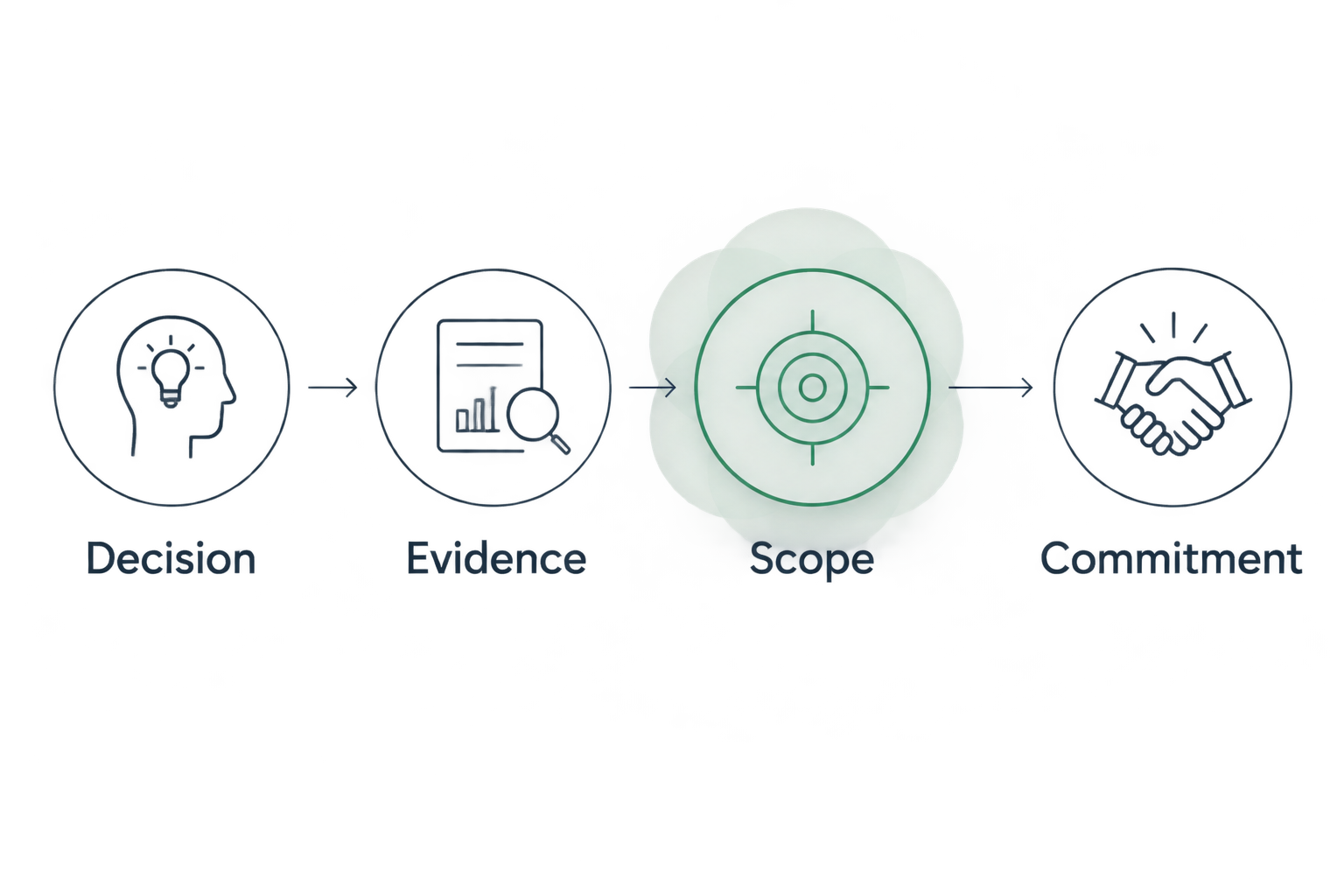
Use the SCOUTz Evidence-to-Agreement Framework to structure the conversation: Find the decision, Bring the evidence, Build the scope, Earn the next commitment. This is a conversation framework, not a proven close-rate intervention.
The following 4 steps are an illustrative workflow. They do not describe a real client incident or a measured sales result.
Decision
Find the decision before discussing tools. Establish whether the client wants help reviewing an alert, checking an existing response process, or deciding who should own future notifications.
Illustrative dialogue: An MSP asks the client to identify who reviews executive exposure alerts today. The client names an internal administrator. The next decision is whether that administrator wants outside validation support, rather than whether the entire security stack should change.
Evidence
Bring the evidence with its limits attached. Show the source, observation date, affected identifier, and the specific condition reported. Explain which facts your team has verified and which facts remain unknown.
Illustrative dialogue: The MSP explains that a provider reported an identifier match. Current credential validity and account access remain unknown. The proposed next step is an authorized review with the account owner, not a declaration that the executive has been compromised.
Scope
Build the scope around the agreed outcome. Use the notification, validation, and response choices above to identify who performs each task and where your responsibility ends.
When a buyer asks about executive dark web monitoring costs, make the comparison about included work: alert delivery, identity validation, escalation, authorized response, and reporting. Keep commercial terms separate from unsupported claims about hypothetical breach losses.
Commitment
Earn the next commitment by making the choice specific. Ask the client to authorize a defined review, introduce the responsible administrator, or confirm that the current provider owns follow-through.
Record the decision, owner, and agreed follow-up date. The client retains the choice to proceed, defer, use an existing provider, or decline.
Handle objections without inflating the claim
The client already has monitoring
Treat existing coverage as something to understand. Ask who receives alerts, how identity matches are reviewed, and where actions are recorded. Compare responsibilities before proposing another service.
Illustrative response: Your current provider can remain the response owner. The proposed work is to confirm the handoff and document coverage boundaries. If that process already meets your needs, keep it.
The client says the exposure was handled
Accept that as relevant context and request the appropriate closure record through an authorized channel. Do not call the problem unresolved merely because the exposure record still appears in a source.
Illustrative response: Record the completed action and its date, then separate that response evidence from the historical exposure record. Any remaining unknown should have its own explanation.
The client wants proof of compromise
State the boundary directly. An exposure match does not establish account access. A configuration review also answers a different question from an incident investigation.
If the client requests an investigation, agree its scope, authorization, and responsible team before collecting additional evidence. Do not quietly expand a sales assessment into incident response.
Put proof into the proposal and follow-up
Your 2026 proposal should name the monitored identities, evidence sources, review responsibilities, permission boundaries, and escalation route. State how disputed matches and unread sources will appear in reports. Leave room for client decisions rather than implying every finding requires a purchase.
Use Evidence, Insight, and Proof as separate reporting elements:
- Evidence records what the source showed and when the relevant check ran.
- Insight explains the possible consequence and the decision the client needs to make.
- Proof records the authorized action and the verification appropriate to that action.
For configuration findings, a rescan against a pinned baseline can show what changed. For a credential-exposure record, document the response separately; do not promise that resetting a password will erase the historical record from an external source.
An illustrative follow-up should summarize the observation, preserve the unknowns, name the owner, and request the agreed authorization. Avoid attaching frightening screenshots as a substitute for explaining the work.
SCOUTz cybersecurity prospect intelligence supports sales preparation; the MSP owns the relationship, scope, and sale. For MSPs evaluating that workflow, Join Open Beta is the primary next step. Use the demo conversation to confirm fit and current product boundaries.
Prepare an evidence-led prospect conversation
Discuss dated domain evidence, consented Microsoft 365 review, and the boundaries of your proposed workflow.
FAQ
Is executive credential monitoring worth it for small MSP clients?
Executive credential monitoring is worth it when the client has a defined need and an accountable response workflow. Start with identity validation, ownership, and existing coverage rather than adding another alert feed by default.
Does an executive's email appearing in breach data prove compromise?
An executive's email appearing in breach data does not prove current account compromise. Preserve the source and dates, then use authorized evidence to investigate the affected identity and account.
Can a public-domain scan show whether an executive has MFA enforced?
A public-domain scan cannot establish an executive's Microsoft 365 MFA enforcement coverage. That requires appropriate authorized internal evidence, with permissions and assessment coverage recorded.
Should an MSP show exposed passwords during a sales pitch?
An MSP should not use exposed-password scare slides during a sales pitch. Present the minimum evidence needed for the decision and route sensitive investigation through an authorized process.
Does resetting a password remove a historical exposure record?
A password reset does not establish that a historical exposure record has been removed from an external source. Keep the source observation separate from the client's documented response and verification.
Can SCOUTz replace an executive credential monitoring service?
SCOUTz's stated role is cybersecurity prospect intelligence using dated domain and Microsoft 365 evidence. Do not assume replacement of an executive credential monitoring service without separately verifying the required sources, coverage, and response functions.
What should an MSP promise in an executive monitoring proposal?
An MSP should promise only the defined work it can deliver: source review, identity validation, escalation, authorized response, and reporting as applicable. Avoid guarantees about security, remediation, contracts, or sales outcomes.
One last thing
A historical match can remain visible after a client has taken appropriate action. Judge your service by whether it preserves that distinction. The most useful report keeps the original observation intact and adds a dated response record, rather than relabeling old evidence to manufacture urgency.