
Instead of manually reconciling old reports before each client meeting, rescan against pinned baseline evidence so you can show what changed, what stayed the same, and what remains unknown. Preserve the original run, repeat the relevant checks, and connect each supported change to an agreed next action.
- SCOUTz cybersecurity prospect intelligence fits MSPs that need dated evidence for sales preparation and client reviews.
- A rescan against pinned baseline evidence proves a supported difference within the assessed scope.
- Keep public-domain observations separate from customer-authorized Microsoft 365 configuration evidence.
- Retain check identity, affected object, source, run date, coverage, and limitations across both runs.
Why this matters
A newer report does not explain a change by itself. Different permissions, check coverage, objects, or sources can produce a different result without showing that anyone fixed the original condition.
SCOUTz cybersecurity prospect intelligence is best for MSPs that need dated evidence to prepare sales conversations and client reviews. The boundary matters: evidence supports the conversation; the MSP owns the recommendation, relationship, and sale. Start with the role of SCOUTz before treating a scan result as an operational conclusion.
For a 2026 review, use evidence, insight, and proof as separate responsibilities. Evidence records what ran. Insight explains the supported consequence. Proof compares a later observation with a preserved baseline and states the limits of that comparison.
Before you start
- Obtain access to the original evidence and the later review, including check identities, affected objects, sources, run dates, and coverage. Assign 1 accountable owner to approve the comparison.
- Confirm the authorized scope. Public-domain evidence and customer-approved, read-only Microsoft 365 evidence require separate treatment; Microsoft 365 review covers configuration and metadata, never mail, files, chats, documents, or prompts.
- Preserve the baseline before changing anything. The non-obvious gotcha is lost read access: a finding that disappears because a source becomes unreadable is unknown, not resolved.
Keep 2 scan records for the comparison: the preserved original and the later run. Preserve 1 baseline for each agreed comparison period rather than silently replacing it whenever a new scan arrives.
This is a record-level workflow. The field names below are suggested documentation labels, not claims about application buttons or automatic integrations. Apply the same evidence requirements in your review record, report, and meeting notes.
Baseline record
Preserve the original evidence
- Identify the account and exact domain, tenant, or affected object. Record the source boundary before interpreting the finding.
- Retain the original run date and check identity. Preserve the supporting observation alongside the finding summary so a reviewer can inspect the basis of the claim.
- Record evidence state and coverage separately. Verified, Observed, Inferred, Possible, Unknown, and Unreadable describe evidence states; Assessed, Partial, Not assessed, Permission limited, and License limited describe coverage.
- Write the intended outcome and accountable owner. Keep the desired condition separate from a vendor or implementation choice.
- Preserve the record unchanged for this comparison. Add later explanations as dated annotations rather than rewriting the original observation.
Expected result: another practitioner can identify what was observed, when it was observed, which object it concerned, and what the scan could not establish.
For an illustrative 2026 baseline, a published DMARC record with p=none supports the statement that the policy requests monitoring rather than quarantine or rejection. It does not establish compromise, the completeness of legitimate sender discovery, or whether monitoring remains the owner's intended policy.
Keep the record literal. A useful proposed outcome is to agree the intended DMARC policy after reviewing legitimate sending sources and reporting. Changing enforcement without that review is a separate implementation decision.
Define the acceptance boundary
Write the acceptance condition before remediation begins. For DMARC, distinguish a published policy change from successful handling of legitimate mail. The first can be observed in DNS; the second requires evidence beyond the policy text.
If the original finding needs closer inspection, use the guide to validating security findings before a call. Validation belongs before the baseline becomes evidence in a proposal.
Rescan scope
Match the review to the original claim
- Select the same account and affected object. Treat renamed, removed, or migrated objects as an identity question before treating them as changed findings.
- Repeat the relevant evidence collection within the authorized scope. Keep public observations separate from customer-authorized tenant evidence.
- Check whether permissions, licensing, source accessibility, and assessed coverage still support the original comparison.
- Record the later run date and any material check-definition changes. A changed assessment method needs an explanation alongside the result.
- Retain declared non-reads under
NOT ASSESSED THIS SCAN. Route unread evidence to an explicit follow-up decision.
Expected result: you have a later observation that either supports a like-for-like comparison or clearly explains why the comparison is limited.
Choose the review scope by the claim you need to verify. These options answer different questions.
| Review option | Best for | Useful evidence | Limit |
|---|---|---|---|
| Public Domain Review | MSPs verifying publicly observable domain and email-security conditions | Dated observations from public-domain sources | Cannot establish tenant Conditional Access coverage, application permissions, license assignments, Intune state, or tenant sharing configuration |
| Customer-authorized Microsoft 365 Review | MSPs reviewing internal tenant configuration with consent | Read-only configuration and metadata evidence within approved access | Conclusions depend on permissions, licensing, and readable sources; Microsoft 365 Review is Open Beta in the October 15, 2026 client reference |
Use the narrowest authorized scope that can support the claim. More sources add context, but different platforms must retain separate assessments rather than being folded into a single score.
Comparison record
Separate observation from explanation
- Match each original check to its later counterpart using check identity and affected object. Do not rely on similar summary wording alone.
- Write the baseline observation and rescan observation side by side. Attach the source and run date to each.
- Describe the difference in the underlying evidence. Keep the explanation narrower than the evidence boundary.
- Record remaining unknowns and any coverage changes. Distinguish a newly discovered condition from a condition proven to have appeared since the baseline.
- Have a practitioner approve the claim before sharing the comparison with a business owner.
Expected result: each comparison has an inspectable basis, a bounded interpretation, and a named reviewer.
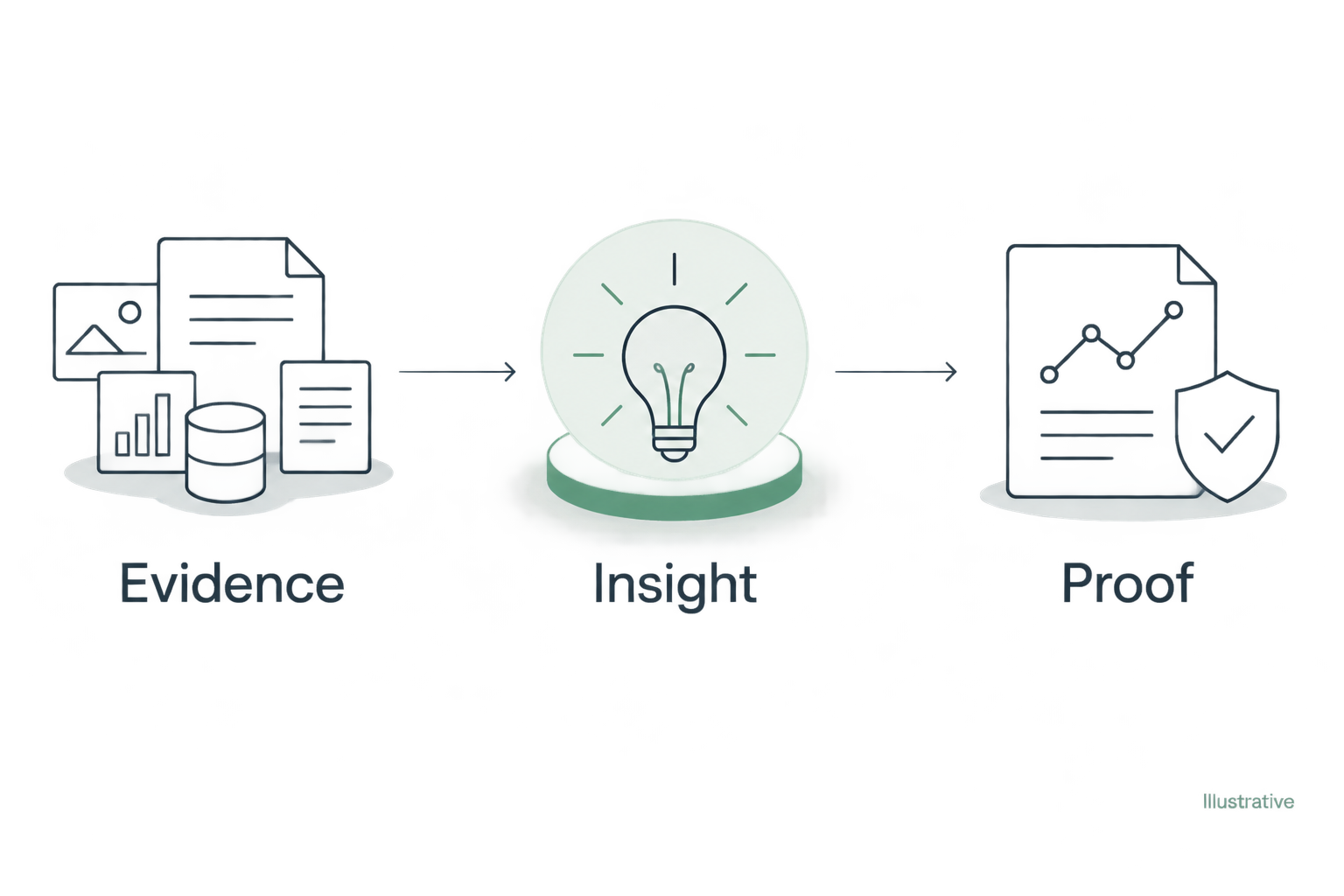
Use this evidence sequence for each material finding:
- Evidence: preserve the original observation and the later observation.
- Insight: explain the supported difference and its practical relevance.
- Proof: confirm whether comparable evidence demonstrates the agreed outcome.
For an illustrative comparison, suppose a baseline from October 20, 2026 records a DMARC policy of p=none, and a rescan from October 24, 2026 records p=quarantine. The supported statement is that the observed published policy changed between those runs.
That comparison does not prove every legitimate sender passes authentication or every receiving system handled messages as intended. Preserve those boundaries even when the change matches the agreed configuration outcome.
Use precise comparison language: “changed as observed,” “unchanged as observed,” “newly observed,” or “not comparable.” These are working descriptions for your comparison record, not substitutes for the underlying evidence states.
Client proof packet
Turn the comparison into a decision
- State the condition and affected object. Include both run dates and a concise description of the observed difference.
- Show the supporting evidence. Keep the check identity, source, coverage, and limitations accessible to the reviewer.
- Identify the owner and agreed outcome. Separate completed work from remaining investigation or implementation.
- Offer the next choice: accept the scoped outcome, investigate a remaining question, authorize additional work, or take no further action.
- Record the decision and the condition that will trigger another review. Preserve the baseline and rescan references with the account context.
Expected result: the client can distinguish completed evidence-backed work from an open question and choose the next action without a security scare story.
Apply the SCOUTz Evidence-to-Agreement Framework: Find the decision, Bring the evidence, Build the scope, Earn the next commitment. It is a conversation framework, not a proven sales-performance intervention.
Illustrative dialogue: “The published policy changed between these dated observations. That meets the configuration outcome we agreed. Sender behavior remains a separate validation task. Would you like that task scoped, or should the review stop here?”
If the client says the issue was already fixed, accept that possibility. Compare the dated evidence with the claimed change and investigate any mismatch before proposing more work.
Repeat the comparison after an approved change
Use the same workflow after an approved configuration change or before a recurring review. Select the relevant comparison period deliberately. A project closeout and a year-over-year review can need different baselines.
For a recurring 2026 QBR, retain the original agreed baseline and add the latest comparable observation. If you also compare against the immediately preceding run, label that as a separate comparison so recent movement does not obscure the longer-term record.
After scope materially changes, establish a new baseline for the new scope. Preserve the older baseline for historical reference. Explain when coverage expanded rather than presenting newly visible conditions as proven deterioration.
Automatic triggering is separate from evidence validity. Repeat this workflow when the approved work is ready for verification; do not assume that a ticket update, email open, or changed report title proves a security outcome.
Troubleshooting
The finding disappeared after access changed
Check permissions and source readability before accepting resolution. Record Permission limited or another applicable coverage state, preserve the original finding, and seek authorized access if verification is still required.
The domain or tenant no longer matches
Confirm the exact affected object and whether a migration, rename, or removal occurred. Document the relationship between old and new objects; open a new baseline when continuity cannot be established.
The check changed between runs
Inspect the check definition and supporting observations. Mark the comparison as limited or not comparable when the revised method cannot support the same claim, then establish a baseline using the revised method.
DNS observations disagree
Record the queried source and observation time. DNS caching and propagation can produce different views, so repeat the relevant observation and avoid declaring a stable outcome from conflicting evidence.
The summary improved but the original question remains
Return to the affected object and acceptance condition. A summary score does not establish that the specific intended outcome occurred, and a score change does not establish an incident.
Customize your workflow
Keep separate records for technical evidence, client decisions, and delivery work. The CRM owns the relationship; the PSA, RMM, and security platforms run delivery. Carry the evidence reference into those records without claiming an integration that has not been established.
For multi-person teams, name the technical reviewer and client-facing owner separately. Agree when evidence expires for the decision at hand rather than applying an unsupported universal freshness window.
Join Open Beta is the primary next step for MSPs evaluating SCOUTz. Use a demonstration to review the evidence boundaries and the rescan workflow against your intended use.
Review your evidence workflow
Discuss baseline preservation, rescan comparisons, and the boundaries of client-facing proof.
FAQ
What does rescan against pinned baseline mean?
A rescan against pinned baseline compares a later observation with a preserved original evidence record. A defensible comparison retains the check identity, affected object, source, run dates, coverage, and limitations.
Does a resolved finding prove the client is secure?
No. A supported comparison establishes only the specific observed outcome within the assessed scope. Unread sources and unassessed controls remain explicit limitations.
Can a public-domain rescan verify Microsoft 365 Conditional Access?
No. Public-domain evidence cannot establish Conditional Access coverage. That claim requires customer-authorized internal evidence with sufficient readable scope.
What should I do if the rescan cannot read the original source?
Record the evidence as unreadable or unknown and document the applicable coverage limitation. Preserve the original finding rather than treating its disappearance as resolution.
Should I replace the baseline after every scan?
Preserve the baseline for the agreed comparison period. Establish a new baseline when the review scope or comparison purpose changes, while retaining the historical record.
Can I automate the workflow when a remediation ticket closes?
Ticket closure can prompt verification, but it does not prove the intended security outcome. Confirm the actual collection and integration capabilities before designing an automated trigger.
What belongs in a client-facing rescan report?
Include the original observation, later observation, both run dates, affected object, source, coverage, limitations, owner, and next decision. Keep implementation choices separate from the evidence-backed outcome.
One last thing
Preserve successful evidence with the same care as concerning evidence. A clean-looking summary without readable supporting observations cannot demonstrate the agreed result. Your strongest closeout is a narrow claim that another practitioner can inspect and the client can understand.


