
MSPs should add dark web monitoring when an identified client need, a named response owner, and an agreed verification process justify the service. The hidden commitment is the work after an alert: validating the match, checking its relevance, and agreeing on a response. For your 2026 stack review, buy the response workflow before adding another alert feed.
- Add dark web monitoring to MSP stack decisions only when someone owns validation, client communication, and response.
- A breach-data match does not establish a compromised user, a working password, or an unresolved incident.
- SCOUTz supports MSP prospect intelligence and sales preparation; evaluate dark web monitoring as a separate operational job.
- Keep public-domain observations separate from customer-authorized Microsoft 365 evidence.
Why this matters
A monitoring alert creates a decision for your service team. Someone must establish what was observed, whether the affected identity still belongs to the client, and what evidence supports the next action.
Sales teams face the same boundary. Before using an alert in a meeting, validate the security finding before the call. A historical exposure presented as an active compromise turns an uncertain signal into an unsupported claim.
Your 2026 service plan should separate monitoring, investigation, remediation, and sales preparation. Each needs an owner and a stated scope.
Should MSPs add dark web monitoring to their stack?
Add dark web monitoring when you can explain what it contributes and who acts on its results. Defer the purchase when your team cannot describe the evidence it needs, the response it offers, or the boundary between routine review and incident investigation.
Compare the jobs before comparing vendors:
| Option | Best for | Useful contribution | Limit or trade-off |
|---|---|---|---|
| Dark web monitoring | MSPs with an exposure-review service and response owner | Surfaces provider-reported exposure matches for investigation | A match alone does not establish present account compromise; source coverage needs review |
| Public-domain review | MSPs preparing an external domain or email-security conversation | Records observable conditions such as published email-security policies | Cannot establish internal tenant controls or current credential validity |
| Customer-authorized Microsoft 365 review | MSPs assessing agreed tenant configuration and metadata | Supplies internal evidence within granted permissions and supported coverage | Unread, permission-limited, and license-limited areas remain separate gaps |
| Existing workflow without another feed | MSPs whose immediate need is better handling of current findings | Keeps attention on ownership, validation, and client follow-through | Leaves any unmet exposure-monitoring requirement unresolved |
These options answer different questions. A public-domain observation cannot establish Conditional Access coverage, application permissions, license assignments, Intune device state, or tenant sharing configuration.
An exposure match also cannot answer those questions. Keep the source and assessment boundary attached when combining evidence in a client report.
Add monitoring when the response is defined
Best for MSPs with a client-approved exposure-review service, this approach gives alerts somewhere useful to go. Before selecting a provider, document the identities or domains in scope, the person responsible for triage, the escalation route, and the evidence needed to close a task.
Require a sample alert during evaluation. Inspect the source description, affected identifier, available dates, confidence explanation, and stated limitations. Ask how the provider handles repeat matches and what an unread or unavailable source means.
The benefit is a defined path from observation to a client decision. The trade-off is the ongoing review work, including cases that remain uncertain after triage.
Recommendation: add monitoring only after the service owner accepts that work. A dashboard with no response commitment leaves the client and the technician guessing about what the service includes.
Defer monitoring when the gap is follow-through
Best for MSPs with unassigned findings or incomplete client actions, deferral keeps the buying decision tied to the actual problem. Review your current process before introducing another source.
Check whether technicians record evidence dates, distinguish observations from inferences, and preserve the result of previous investigations. Check whether clients know which actions require their approval.
The benefit is clearer ownership before expansion. The trade-off is that deferral does not satisfy a genuine requirement for exposure monitoring, so document that uncovered requirement rather than treating it as resolved.
Recommendation: fix the handoff first, then reconsider the feed. Set a review point tied to completion of the workflow, rather than assuming another subscription will create it.
Why the decision varies between MSPs
Your client mix and service boundaries matter more than the appeal of a new alert category. Use these factors in your 2026 evaluation:
- Client need: identify the decision that exposure monitoring would support and who has asked for it.
- Evidence quality: examine the provider's source descriptions, dates, confidence language, and handling of uncertain matches.
- Response ownership: assign responsibility for validation, client contact, escalation, and closure.
- Existing coverage: establish whether another service already provides the relevant evidence and response.
- Authorization and handling: agree on scope, permitted recipients, retention, and how sensitive evidence will be shared.
- Verification limits: decide what can be demonstrated after an action and what remains outside the review.
These factors belong in the service description. A client should understand the difference between receiving a notification and purchasing investigation or remediation.
Use evidence, insight, and proof without collapsing them
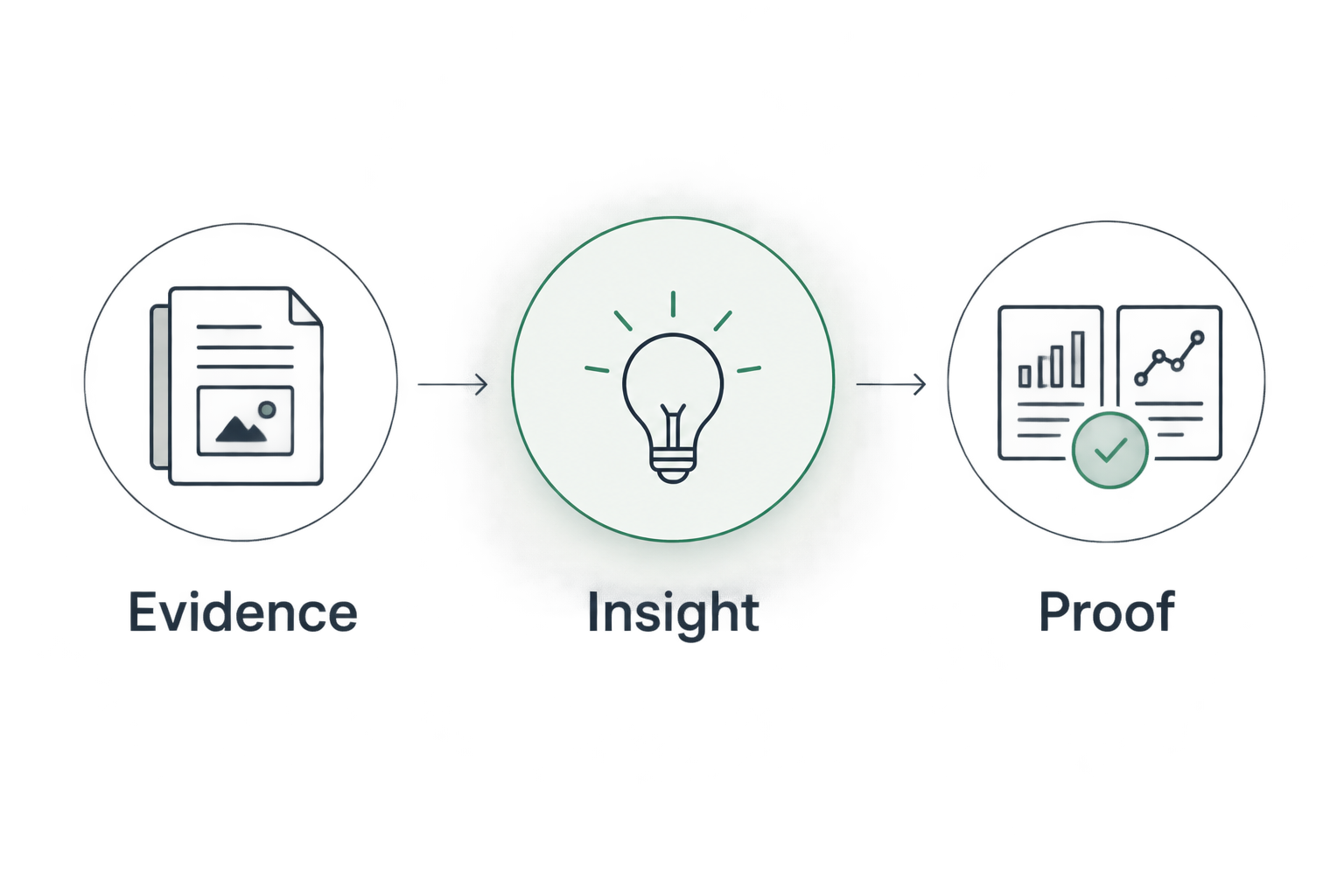
Evidence records what ran and what it returned. Insight explains why the observation deserves attention within its limits. Proof records what changed against a pinned baseline, where a comparable recheck is possible.
For a provider-reported exposure match, preserve the affected identifier, source reference, retrieval date, and any event date supplied by the provider. Keep the observation date separate from the date the underlying data reportedly originated.
The possible consequence is conditional: an exposure warrants an identity and account review within the agreed scope. It does not establish that the account remains active, that a password still works, or that the client has an unresolved incident.
Assign the review to the agreed owner, then offer a specific next choice: validate identity ownership, authorize a scoped review, or record that no further action is agreed.
A completed password reset does not erase a historical exposure record. Report the action and its verification separately from any continued appearance of the original match.
Keep public evidence separate from tenant evidence
An external domain review and an authorized tenant review have different access boundaries. Your 2026 report should state both, even when the findings appear in the same presentation.
For public-domain evidence, record the domain, check, run date, observed condition, and limitations. For Microsoft 365 evidence, record the authorized scope, run date, readable sources, and any permission or license restrictions.
SCOUTz prospect intelligence separates public-domain observations from customer-authorized, read-only Microsoft 365 configuration and metadata evidence. That internal evidence excludes mail, files, chats, documents, and prompts; the review makes no automatic configuration changes.
SCOUTz is best for MSP owners and sales leaders preparing prospect conversations with dated cybersecurity evidence. Its prospect-intelligence role leaves operational monitoring requirements to be evaluated on their own scope and merits.
Keep evidence states distinct: Verified, Observed, Inferred, Possible, Unknown, and Unreadable describe different claims. Coverage states such as Assessed, Partial, and Not assessed describe what the review reached. Unread evidence remains unknown.
Turn the finding into an agreed next action
Use the SCOUTz Evidence-to-Agreement Framework to structure the conversation: Find the decision, Bring the evidence, Build the scope, Earn the next commitment. This is a conversation framework, without a demonstrated close-rate result.
Find the decision
Establish what the buyer needs to decide. A prospect considering ongoing monitoring faces a different decision from a client reviewing an isolated exposure notification.
Illustrative dialogue:
MSP: Before we recommend a service, let's agree on the outcome you want. We can review this observation, define an ongoing monitoring service, or decide that your existing provider already owns the response.
Buyer: We need to establish who would act on an alert.
The useful next step is an ownership discussion. Preserve the buyer's ability to decline additional scope.
Bring the evidence
Present the condition with its source and date. Explain what the evidence supports, then identify what remains unknown.
Illustrative dialogue:
MSP: The provider reported a match associated with this identifier. The report does not establish current access to your systems. With your approval, the account owner can confirm whether the identity is current and review the relevant controls.
Keep sensitive material out of a general sales deck. Use the minimum evidence needed for the decision and agree on appropriate recipients.
Build the scope
Offer distinct scopes rather than bundling every finding into a broad security proposal. A scoped review establishes relevance; ongoing monitoring adds continuing intake and response responsibilities.
| Scope | Best for | Deliverable | Boundary |
|---|---|---|---|
| Exposure review | A client deciding whether a specific match requires action | Dated observation, identity validation, unknowns, and agreed next step | Does not establish complete tenant posture |
| Authorized tenant review | A client seeking configuration evidence | Findings from readable, permitted configuration and metadata sources | Does not prove credential abuse occurred |
| Ongoing monitoring service | A client requiring continuing exposure review | Defined intake, ownership, escalation, and reporting process | Coverage and response commitments require explicit agreement |
Keep the recommended outcome separate from the vendor choice. The MSP and buyer can choose a product, service, process change, project, or no additional work.
Earn the next commitment
Ask for the smallest action that advances the agreed decision. That might be naming the account owner, approving a review scope, or scheduling a findings discussion.
Illustrative follow-up:
MSP: We agreed to confirm identity ownership before recommending ongoing monitoring. Please nominate the person authorized to review the match. After that review, we will document the evidence, remaining unknowns, and available next steps.
An email open remains a follow-up cue. Record agreement only when the buyer actually provides it.
Evaluate the evidence-preparation role separately
In its October 15, 2026 product reference, SCOUTz lists Microsoft 365 Review, Evidence Reports / Studio + Reports, Prospect Intelligence, and Guided Remediation as Open Beta. Use those dated labels when assessing fit; beta validation is a consideration for your own workflow.
For a 2026 evaluation, bring a sample account, a permitted evidence scope, and the decision your salesperson needs to support. Ask for a demonstration of source dates, declared non-reads, and the distinction between observation and implication.
The evidence-preparation role supports discovery and proposal scope. The relationship, operational service commitments, and sale remain the MSP's responsibility.
Review your evidence workflow
Discuss domain and Microsoft 365 evidence for MSP prospect preparation.
FAQ
Should a small MSP add dark web monitoring?
A small MSP should add dark web monitoring when a defined client need and a named response owner justify it. If nobody owns validation and client follow-through, establish that workflow before adding another feed.
Does a dark web alert mean a client was breached?
A dark web alert alone does not establish that a client was breached. Preserve the provider's evidence and investigate the affected identity, dates, and current account context before making a stronger claim.
Can a domain review replace dark web monitoring?
A domain review serves a different job from dark web monitoring. Public-domain evidence describes observable conditions; provider-reported exposure matches require their own source review and validation.
Does Microsoft 365 configuration evidence prove an account is safe?
Microsoft 365 configuration evidence does not prove an account is safe. Report the controls actually assessed, the review date, and any unread or permission-limited sources without turning them into a blanket assurance.
Can MSPs use dark web findings in a sales conversation?
MSPs can discuss appropriately handled exposure evidence while preserving its source, date, and limits. Do not present a match as confirmed compromise, buying intent, or proof of an unresolved problem.
What should an MSP ask a dark web monitoring provider?
Ask the provider to explain source coverage, evidence dates, match confidence, repeat alerts, and response boundaries. Evaluate a sample alert against the workflow your team will actually deliver.
What counts as proof after an exposure alert?
Proof documents the agreed action and the evidence used to verify it. A completed account action and a historical exposure record are separate facts, so report each without implying the old record must disappear.
One last thing
A historical match can remain visible after a useful action is complete. If your closure rule requires the original record to disappear, the rule confuses evidence history with remediation status.
Define closure before offering the service. Record the observation, the authorized action, the verification result, and the remaining uncertainty so the client can distinguish completed work from continuing exposure evidence.