
Logistics cybersecurity risk assessment is the review of evidence about systems supporting freight operations, with the aim of choosing defensible security actions. For MSPs selecting cyber security risk assessment tools for logistics companies in 2026, the starting point is the operational dependency: dispatch, carrier communications, shipment documents, customer portals, or another workflow the prospect confirms.
- Choose cyber security risk assessment tools for logistics companies by evidence coverage, authorization boundaries, and repeatable verification.
- SCOUTz is best for MSPs preparing evidence-led logistics prospect conversations, not establishing complete operational security coverage.
- Public-domain observations cannot establish Microsoft 365 tenant controls, warehouse device security, or transport application resilience.
- Connect each finding to a confirmed workflow, a responsible owner, and an agreed next action.
Why cybersecurity risk assessment matters for logistics companies
A logistics prospect meeting needs a specific decision. Establish whether you are discussing email identity, access to shipment documents, an operational application, or recovery readiness before selecting an assessment tool.
SCOUTz provides cybersecurity prospect intelligence for MSPs: dated domain and customer-authorized Microsoft 365 evidence for sales preparation. Start with SCOUTz when the job is preparing that conversation, then identify the assessment work outside that boundary.
For a 2026 review, ask the prospect to name the workflows that matter and the people responsible for them. A domain observation becomes relevant when you can connect it to a confirmed dependency, such as an email domain used for carrier instructions. That connection still does not establish an incident or an unresolved problem.
Choose tools by the decision they support, then preserve the limits of their evidence.
How to build an evidence-led logistics assessment
1. Define the decision
Start manually with a worksheet and a discovery conversation. Record which business workflow is under discussion, which systems support it, and what the buyer wants to decide. Avoid treating a freight broker, warehouse operator, and carrier as interchangeable assessment targets.
Use the Find the decision stage of the SCOUTz Evidence-to-Agreement Framework. This is a conversation framework, not a proven sales-performance intervention. Its purpose is to connect assessment work to a buyer-approved choice.
Keep the initial scope narrow enough to explain. For example, reviewing the domain used for customer notifications is a different assignment from testing whether dispatch can recover after a system failure. One finding cannot answer both.
- Name the legal entity and business domain being reviewed.
- Ask which workflow the prospect wants to examine.
- Identify the business owner and technical administrator.
- Record who can authorize access or active testing.
- Write the decision the review should support.
2. Separate evidence sources
Use public DNS lookups and published records for an initial domain review. Record the query, returned evidence, affected domain, and collection date. Distinguish public observation from active probing; obtain appropriate authorization for the activity you plan.
For a logistics prospect using Microsoft 365, request customer-authorized access before reviewing internal tenant evidence. SCOUTz cybersecurity prospect intelligence separates public-domain observations from consented cloud evidence. The client’s October 15, 2026 product reference describes read-only review without agents or automatic configuration changes.
Microsoft 365 evidence is configuration and metadata only. It excludes mail, files, chats, documents, and prompts. A public domain review cannot establish Conditional Access coverage, application permissions, license assignments, Intune device state, or tenant sharing configuration.
Put those boundaries in the evidence packet itself. A salesperson should not need a separate technical briefing to discover that an important source was unreadable.
- Label each source as public or customer-authorized.
- Attach the check name and run date to each finding.
- Record the affected domain, tenant, or other object.
- Keep evidence state separate from assessment coverage.
- Put declared non-reads under NOT ASSESSED THIS SCAN.
3. Validate the condition
Recheck an observation manually before using it in a prospect conversation. Confirm that the domain belongs to the prospect, inspect the underlying result, and establish whether the evidence still supports the wording in your report.
Consider a hypothetical DMARC observation: a published policy requests monitoring only. That describes the policy observed. It does not establish mailbox compromise, prove that legitimate sending sources are mapped, or show that the setting contradicts the owner’s intention.
For logistics discovery, ask whether the domain carries carrier instructions, customer notifications, or another confirmed workflow. Then identify who reviews authentication reports and approves policy changes. Keep the observed setting separate from the business consequence you are investigating.
Use the guide to validating security assessment findings before a call to structure the handoff from technician to salesperson.
- Reproduce the relevant lookup or authorized check.
- Preserve the source result with its collection date.
- Distinguish Observed evidence from Inferred consequences.
- Record intended exceptions and unanswered questions.
- Obtain technical sign-off on the customer-facing claim.
4. Explain the consequence
Bring the evidence into discovery without turning it into a threat forecast. Start with the observed condition, explain its boundary, and ask how the business manages the relevant workflow. The buyer supplies operational context that a scan cannot establish.
Use a small meeting packet. As a working limit for your 2026 sales process, bring 3 findings that support the agreed decision rather than reading every result aloud. This is a presentation recommendation, not a claim about buyer behavior.
The following dialogue is illustrative, not a customer exchange or a reported scan result:
MSP: The published DMARC policy requests monitoring only. That does not establish compromise. Who owns the sending inventory for carrier and customer communications?
Prospect: Our provider manages the domain, but operations approves notification systems.
MSP: Would a joint review of the sending inventory and intended policy be a useful next step?
- State the condition before discussing a possible consequence.
- Name the workflow only after the prospect confirms it.
- Identify who owns the setting and business process.
- Ask whether the observed condition remains intended.
- Offer a bounded review rather than presuming remediation.
5. Build the scope
Build the scope around an agreed outcome, not a preferred vendor. Use a document or spreadsheet first: list the affected object, current evidence, unknowns, proposed work, exclusions, and acceptance criteria.
For a logistics prospect, compare 2 scopes when the evidence supports them: a focused email-domain review and a broader customer-authorized identity review. Explain what each answers. Neither scope establishes warehouse network security, transport application resilience, or recovery readiness unless that work is separately included.
SCOUTz evidence can support the proposal conversation, while the MSP remains responsible for interpretation and scope. According to the October 15, 2026 client reference, Microsoft 365 Review and Evidence Reports are Open Beta; multi-client and report experiences remain in beta validation. Evaluate those limits before making them part of your delivery process.
For the illustrative DMARC case, an acceptance criterion is documented sending sources, an owner-approved policy decision, and dated verification after any authorized change. Do not promise that a policy change will prevent every impersonation attempt.
- Define the question each proposed scope answers.
- Separate assessment work from configuration changes.
- State access requirements and operational exclusions.
- Identify the person who approves the outcome.
- Define evidence-based acceptance criteria.
6. Earn the commitment
Close discovery with a specific next choice. The prospect can authorize a review, include another owner, defer the decision, or decline. A finding does not establish buying intent, and agreement to review evidence does not establish agreement to buy services.
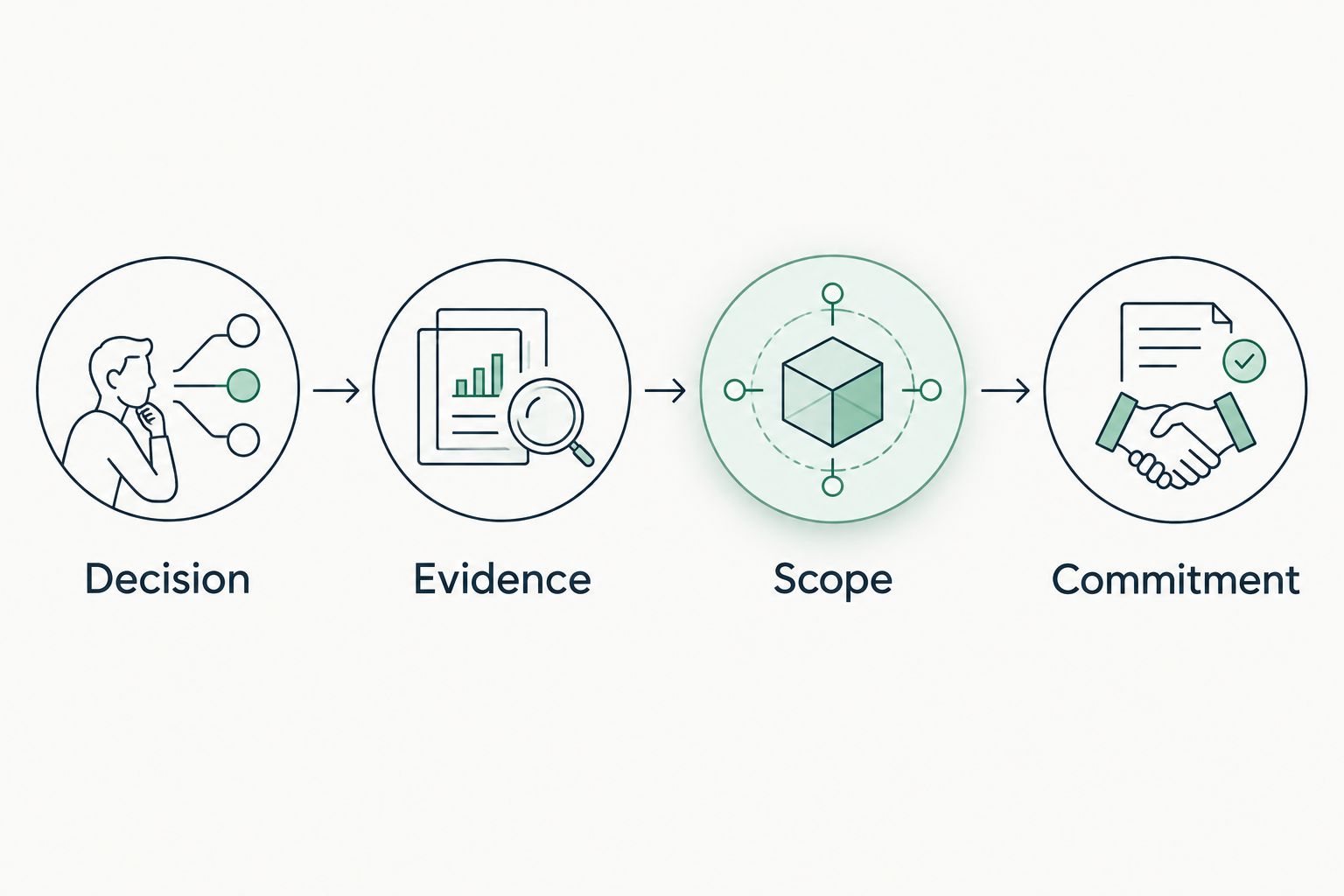
Use the complete conversation sequence: Find the decision, Bring the evidence, Build the scope, Earn the next commitment. For your working notes, shorten those stages to Decision, Evidence, Scope, and Commitment.
Send a follow-up that preserves the evidence date and the agreed boundary. A pinned baseline gives a later rescan something specific to compare against; a changed score alone does not explain what changed.
Illustrative follow-up: We agreed to review the sending inventory with your domain administrator and operations owner. The current packet records a monitoring-only policy; it does not establish compromise. Please confirm the review owner and approved scope before we proceed.
- Record 1 accountable owner for the next action.
- Confirm the authorization and scope in writing.
- Agree on a review date with the prospect.
- Pin the evidence baseline before approved changes.
- Rescan the relevant checks and explain the difference.
Compare assessment options by their job
A prospect-intelligence review and an operational security assessment answer different questions. Use this comparison to select the next layer of work, rather than treating every option as a substitute for the others.
| Option | Best for | Useful contribution | Key limitation |
|---|---|---|---|
| Manual public-domain review | MSPs investigating a narrow domain question | Direct inspection of published records and a traceable starting point | Requires manual interpretation; cannot establish internal tenant controls |
| SCOUTz domain and authorized Microsoft 365 reviews | MSPs preparing evidence-led prospect conversations | Dated evidence and account context for discovery and proposals | Microsoft 365 and report capabilities carry the client’s Open Beta labels; scope does not establish complete logistics security |
| Authorized network vulnerability assessment | MSPs investigating in-scope network exposure | Tests agreed targets for technical weaknesses | Requires explicit scope, authorization, operational coordination, and result validation |
| Application and integration review | MSPs examining transport, warehouse, or partner-system access | Focuses investigation on application permissions and data paths | Requires application-specific access and expertise |
| Recovery exercise | MSPs validating an agreed restoration scenario | Produces evidence about the recovery activity actually tested | Findings apply to the tested scenario, not every possible outage |
Evaluate a 2026 shortlist with a sample evidence packet. Require the source, date, affected object, coverage limits, and validation method. A polished summary without those elements gives your salesperson less to defend.
Common mistakes MSPs make with logistics prospects
Treating email evidence as dispatch evidence
A domain finding concerns the domain and the check performed. It does not establish the security of a dispatch platform, vehicle system, or warehouse network. Ask the prospect to confirm the dependency before connecting the finding to operations.
Assuming every site has the same owner
Identify which company, provider, or internal team controls each in-scope system. A customer portal, branch network, and partner integration require separate ownership questions. Write those answers into the scope rather than assuming the prospect can authorize every test.
Treating an unread source as a clean result
Permission-limited Microsoft 365 evidence remains permission limited. Show what was assessed and what was not assessed. Keep states such as Unknown and Unreadable distinct from coverage labels such as Partial or Not assessed.
Selling a replacement before agreeing on the outcome
Separate the condition and desired outcome from product selection. The appropriate next choice can be a process review, configuration project, service, product, or no change. Confirm ownership and intent before recommending a replacement.
Choose the next step
Join Open Beta is the primary next step for MSPs evaluating this evidence-led workflow. Confirm current capabilities and fit before making the platform part of a client commitment. The relationship, judgment, and sale stay with your MSP.
Review your MSP assessment workflow
Discuss domain evidence, authorized Microsoft 365 reviews, and Open Beta fit.
FAQ
What's the best way to choose cyber security risk assessment tools for logistics companies?
Choose tools by the decision, evidence source, and authorized scope they support. Public-domain reviews support different conclusions from internal identity reviews, network assessments, application reviews, and recovery exercises.
Can a domain review show whether a logistics company's dispatch system is secure?
A domain review cannot establish dispatch-system security. It can provide public-domain observations; dispatch applications, access controls, integrations, and recovery require separately scoped evidence.
Can an MSP review Microsoft 365 before the prospect becomes a client?
An MSP can conduct a customer-authorized review before a services agreement when the authorization and scope permit it. Establish consent, access boundaries, evidence handling, and responsibility before collecting internal tenant evidence.
Does a monitoring-only DMARC policy mean a logistics company has been breached?
A monitoring-only DMARC policy does not establish a breach. Confirm the published policy, ask who reviews reports, and determine whether the setting remains intended before proposing work.
Is a vulnerability scanner enough for a logistics risk assessment?
A vulnerability scanner alone does not answer every logistics assessment question. Match technical testing with the identity, application, ownership, and recovery evidence required by the agreed scope.
How should an MSP prove that an agreed change worked?
Compare a dated rescan against a pinned baseline and the agreed acceptance criteria. Identify the specific condition that changed, preserve remaining unknowns, and avoid treating one successful check as proof of complete security.
One last thing
Backup software presence does not establish recoverability. If recovery becomes part of a logistics proposal, agree on a restoration scenario and the evidence needed to evaluate it. Keep that work separate from domain and tenant observations in your 2026 assessment packet.


