
Utility cooperative security assessment reporting is the practice of documenting dated security evidence to support decisions about assessment scope, ownership, and corrective work. For MSPs, a security assessment report for utility cooperatives must distinguish business IT from operational technology and public observations from customer-authorized internal evidence.
- A security assessment report for utility cooperatives needs dated evidence, explicit coverage limits, and agreed next actions.
- SCOUTz is best for MSPs preparing evidence-led prospect conversations about domain security and authorized Microsoft 365 configuration.
- Keep operational technology outside the report’s conclusions unless separately authorized and assessed.
- Turn each supported finding into an owner, a scoped choice, and a verification plan.
Why security assessment reporting matters for utility cooperatives
The report’s most important boundary is what the evidence can establish. A public email-security observation supports a discussion about that domain. It does not establish the condition of a cooperative’s control systems, internal network, or Microsoft 365 tenant.
Build your 2026 reporting template around that distinction. Before presenting a finding, follow a repeatable process for validating security assessment findings before a call. Keep the underlying observation available for technical review.
A cooperative-facing report also needs a clear audience. Ask which decisions belong to management, which require the IT owner, and which involve operations personnel or an incumbent provider. Establish those responsibilities during discovery rather than assigning them from an organization chart.
The commercial purpose is concrete: help the cooperative agree on the next appropriate piece of work. That decision can be further assessment, a bounded project, a process change, or no change with a recorded rationale.
Build the report from evidence to agreement
Define the decision and assessment boundary
Start manually with a shared scope document. Identify the cooperative entity, domains, business systems, and authorized contacts before collecting evidence. Separate office technology from operational environments, even when the same person coordinates both.
Use a 1-page executive summary as a reporting target, with technical evidence in an appendix. This is a suggested format, not an assessment standard. The summary should state the decision requested and the limits of the review.
For a 2026 assessment, record the actual collection date beside every source. A year in the document title does not establish freshness. Also distinguish permission to review public records from authorization to perform active probing or access a tenant.
Close scope discovery with these actions:
- List the exact domains and authorized tenant, where applicable.
- Name the cooperative contact who approves the review.
- Separate business IT, operational technology, and third-party systems.
- Record permitted methods, exclusions, and access conditions.
- State the decision the report is intended to support.
Collect public-domain evidence with its limits
Use manual DNS queries and public records to establish what is observable about an authorized domain. Preserve the returned record, queried name, collection time, and check interpretation. A screenshot without its source and date is weak evidence for a proposal.
For example, a published DMARC policy of p=none requests monitoring rather than enforcement through that policy. It does not prove that spoofing occurred, that messages were delivered, or that the policy is an unresolved mistake. Ask whether monitoring remains intentional and who reviews the reports.
Do not extend a public-domain review into claims about Conditional Access, application permissions, license assignments, device management, or tenant sharing. Those require different evidence. Public observation and active probing also need separate authorization decisions; do not assume permission for one covers the other.
Keep the collection record specific:
- Save the queried domain or DNS name.
- Preserve the record value and collection timestamp.
- Name the check and its interpretation boundary.
- Record unavailable or unreadable sources explicitly.
- Confirm permission before expanding the collection method.
Add authorized Microsoft 365 evidence
Begin with a customer-authorized, read-only review of relevant configuration and metadata. A manual process can use approved administrative views and exports, provided you preserve source details and document what the reviewer could actually read.
SCOUTz cybersecurity prospect intelligence is best for MSPs preparing evidence-led domain and authorized Microsoft 365 sales conversations. SCOUTz provides dated evidence and account context; Microsoft 365 Review is Open Beta under the client’s October 15, 2026 product reference. Its read-only review covers configuration and metadata, never mailbox contents, files, chats, documents, or prompts.
The platform offers a purpose-built alternative to assembling those findings manually. Its evidence still requires MSP interpretation and sign-off. It does not replace an operational-technology assessment or establish that every tenant control was assessed.
Preserve consent and coverage:
- Record customer authorization and the reviewed tenant.
- Identify the configuration or metadata source.
- Separate Assessed, Partial, and Not assessed coverage.
- Label permission-limited and license-limited collection.
- Place declared non-reads under NOT ASSESSED THIS SCAN.
Translate each finding into a bounded business choice
Use an evidence record with separate fields for condition, affected object, possible consequence, unknowns, owner, and recommended outcome. Keep vendor selection outside the finding itself. The cooperative and MSP choose whether the response is a product, service, process, project, or no action.
For your 2026 report, use 3 initial findings as a suggested discussion limit. This is a meeting-design choice, not a claim that the cooperative has only three issues. Choose findings that support the agreed decision and have evidence the MSP can defend.
A domain finding should not acquire operational consequences merely because the prospect is a utility cooperative. Explain the narrow consequence supported by the source. If the business impact depends on how a system is used, ask the owner before writing that impact as fact.
Complete each finding with these fields:
- Observed condition and affected object.
- Evidence source, check name, and run date.
- Evidence state and separate coverage status.
- Possible consequence and remaining unknowns.
- Responsible owner and the next available choice.
Structure the conversation around an agreed next action
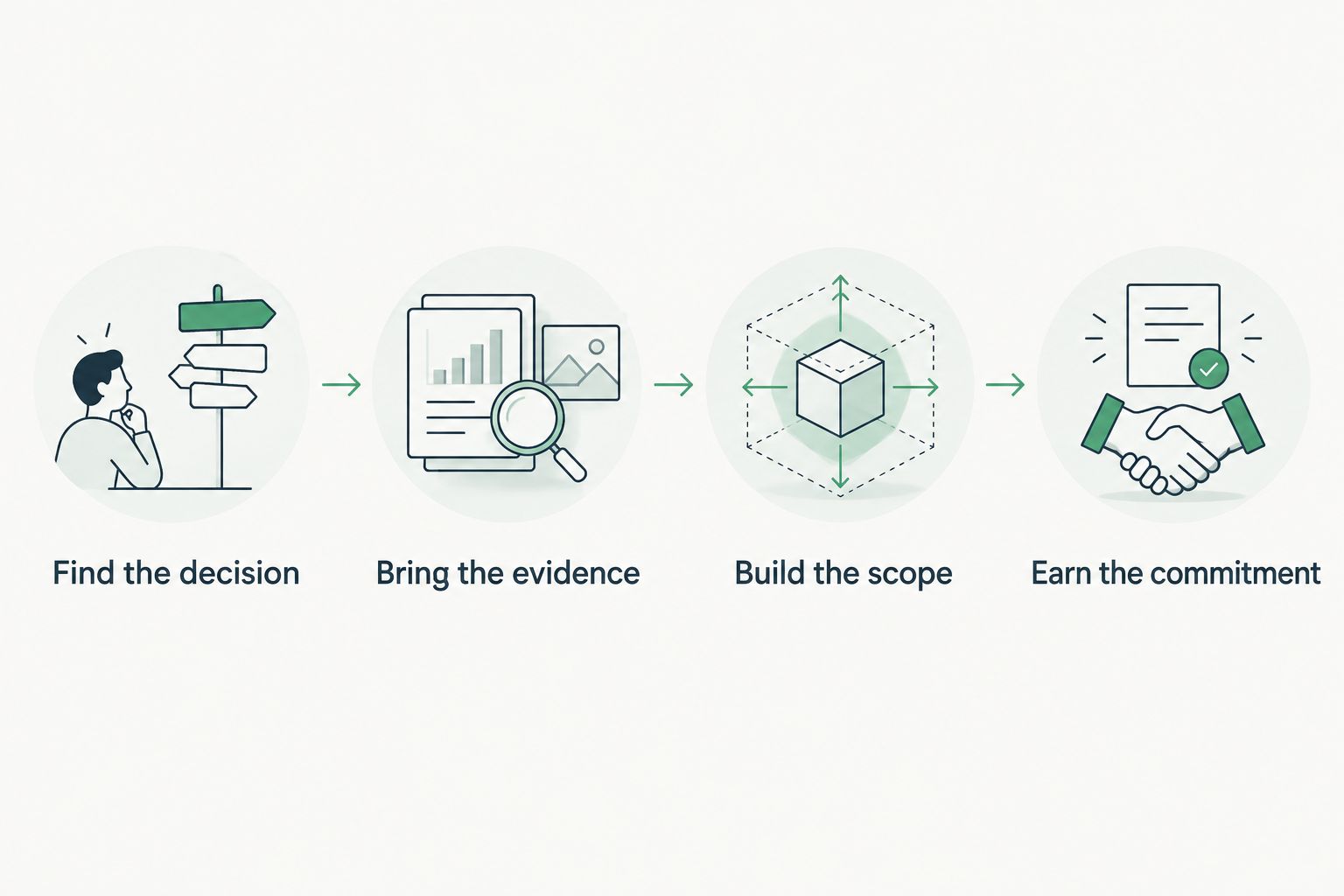
Use the SCOUTz Evidence-to-Agreement Framework: Find the decision, Bring the evidence, Build the scope, Earn the next commitment. This is a conversation framework, not a validated close-rate intervention. It keeps the sales discussion attached to a decision the cooperative controls.
Illustrative dialogue, not a customer transcript:
MSP: The observed DMARC policy requests monitoring. The record alone does not show whether that remains your intended policy.
Cooperative IT owner: Our current provider already manages email security.
MSP: Include that provider in the review. The proposed first step is to confirm the reporting owner and legitimate senders before discussing any policy change.
This response respects the incumbent and narrows the request. It avoids turning an observation into an accusation or a reason to replace a provider.
Move the discussion toward these commitments:
- Find the decision: confirm the policy’s intended purpose.
- Bring the evidence: show the dated record and limits.
- Build the scope: propose sender and reporting review.
- Earn the next commitment: agree on an owner and review date.
Build the proposal around outcomes and exclusions
Write the proposal manually from the accepted finding records. Create 2 reporting views: a decision summary for management and an evidence appendix for technical reviewers. Both should describe the same conditions and boundaries, without changing certainty for different audiences.
Present scope choices by their jobs. An evidence-validation engagement confirms facts and ownership. A configuration project changes agreed settings through a separately authorized process. A broader managed-service proposal needs its own discovery and service definition.
For a 2026 proposal, preserve the evidence snapshot used to justify the scope. If a new observation changes the recommendation, update the proposal rather than quietly replacing the appendix. A scan observation is not permission to make configuration changes.
Include these proposal elements:
- State the agreed outcome and affected objects.
- Identify prerequisites and cooperative responsibilities.
- Separate validation work from configuration changes.
- Exclude operational systems unless separately scoped.
- Define acceptance evidence and the follow-up decision.
Verify changes against a pinned baseline
Save the original evidence before work begins. After an authorized change, repeat the relevant check and compare the same object using a documented method. Proof is the observed difference against that baseline, with collection limits intact.
For a 2026 QBR, show what changed, what remains unknown, and which owner accepted the result. A changed DNS record proves a different published value at collection time. It does not by itself prove correct message delivery, universal enforcement, or protection against every impersonation technique.
Use the same discipline when nothing changed. The cooperative can accept an existing configuration intentionally, defer work, or request additional evidence. Record that decision without presenting it as remediation or security improvement.
Keep verification bounded:
- Pin the original source, object, and run date.
- Repeat the relevant check after authorized work.
- Explain method or coverage differences between runs.
- Record changed, unchanged, and unreadable evidence.
- Obtain owner acceptance and schedule the next review.
Compare reporting options by the job they perform
Choose the reporting method after defining the evidence you need. A useful prospect-preparation workflow and a separately authorized operational assessment answer different questions. Combining their outputs into a single score hides those boundaries.
The options below are complementary. The limitation column defines where each option stops, rather than implying that another option resolves every gap.
| Option | Best for | Main strength | Key limitation |
|---|---|---|---|
| Manual evidence register | MSPs establishing a repeatable report format | Direct control over sources, wording, and review | Collection, interpretation, and updates remain manual |
| Public-domain review | Initial domain and email-policy discussions | Documents externally observable conditions | Cannot establish internal tenant or operational-system configuration |
| Authorized Microsoft 365 review | Reviewing consented tenant configuration and metadata | Connects internal observations to specific configuration questions | Conclusions depend on permissions, licensing, and readable sources |
| SCOUTz cybersecurity prospect intelligence | MSP prospect preparation and evidence-led reporting | Packages dated domain and authorized Microsoft 365 evidence for conversation preparation | Microsoft 365 Review is Open Beta; MSP judgment and separate operational scope remain necessary |
| Separately scoped operational-technology assessment | Questions about operational assets and controls | Addresses the environment explicitly included in its authorization | Requires its own methods, expertise, access agreement, and safety boundaries |
For the platform workflow, Join Open Beta is the primary next step. Confirm the current product scope and assessment boundaries before relying on the output in a cooperative proposal.
Prepare your next cooperative review
Discuss Open Beta scope and evidence-led preparation for your MSP’s next prospect conversation.
Common mistakes MSPs make with cooperative reports
Extending business IT findings into operational conclusions
An email-policy finding does not establish the security of generation, distribution, water treatment, or other operational systems. Name only the environment actually assessed. Bring an authorized operational specialist into scope when the decision requires that expertise.
Assigning ownership before discovery
The cooperative contact receiving the report does not automatically own DNS, tenant administration, or operational equipment. Confirm the responsible person and any provider dependencies before proposing changes. Otherwise, the report asks someone to approve work outside their authority.
Treating utility status as a compliance conclusion
Do not label the report a regulatory audit or certification because the prospect is a utility cooperative. Establish the relevant obligations, assessed scope, and qualified reviewer separately. Map evidence only to requirements that have actually been identified and reviewed.
Leaving a finding without a next decision
A technical appendix can describe a condition accurately while leaving management unable to act. Attach a narrow request: confirm intent, authorize further review, approve a scoped change, or accept the current condition. Preserve the cooperative’s ability to decline.
FAQ
What should a security assessment report for utility cooperatives include?
Include the assessment scope, dated evidence, coverage limits, finding owners, decision requests, and verification plan. Separate business IT from operational technology and public-domain observations from authorized internal evidence.
Can an MSP assess a cooperative without accessing its network?
An MSP can review public-domain evidence without establishing the condition of the cooperative’s internal network. Define authorization and methods first, and distinguish public observation from active probing.
Does a public-domain report show Microsoft 365 security?
A public-domain report cannot establish internal Microsoft 365 configuration. Conditional Access, application permissions, license assignments, and tenant sharing require appropriate customer-authorized evidence.
Is SCOUTz a replacement for an operational-technology assessment?
SCOUTz prepares MSP conversations with dated cybersecurity evidence and account context; it does not replace a separately scoped operational-technology assessment. Keep operational-system conclusions outside a domain or Microsoft 365 review.
Does a monitoring-only DMARC policy prove the cooperative has a security incident?
A monitoring-only DMARC policy does not prove a security incident. Preserve the published record and ask whether monitoring remains intentional, who reviews reports, and what evidence would support a policy decision.
How should an MSP handle evidence it could not read?
Label unread evidence explicitly and preserve the reason collection failed or was limited. Keep evidence states separate from coverage, and place declared non-reads under NOT ASSESSED THIS SCAN.
How does the report support an MSP proposal?
The report supports a proposal by connecting supported observations to an agreed outcome, owner, scope, and acceptance evidence. It does not establish buying intent or guarantee a contract; the MSP remains responsible for the relationship and sale.
One last thing
Put the acceptance test in the report before proposing the work. If neither party can describe what evidence would demonstrate the agreed outcome, the scope needs another conversation.
For a domain-policy review, acceptance might be a documented policy decision with an owner and supporting evidence. A justified decision to retain the current setting is different from a configuration change. Report each accurately.


