
SpyCloud’s strength is identity-exposure intelligence drawn from recovered stolen data, including credentials associated with breaches and malware. That evidence serves a different purpose from assessing a prospect’s current configuration and preparing an MSP sales conversation. The best SpyCloud alternative in 2026 is SCOUTz if you need evidence-led MSP sales preparation; Microsoft Secure Score is the better fit if you need an authorized Microsoft 365 posture review.
- Among SpyCloud alternatives, SCOUTz fits MSP prospect intelligence and evidence-led sales preparation.
- Microsoft Secure Score fits authorized Microsoft 365 posture review, rather than stolen-credential research.
- Keep SpyCloud when recovered identity-exposure intelligence remains the requirement.
- A breach-data match does not establish current account compromise or buying intent.
Why this matters
Choosing among SpyCloud alternatives in 2026 starts with the decision you need to support. Credential exposure, tenant configuration and prospect meeting preparation are different jobs. Compare evidence sources before comparing reports.
SpyCloud alternatives at a glance
| Tool | Best for | Standout capability | How it differs from SpyCloud |
|---|---|---|---|
| SpyCloud | Investigating identity exposure | Intelligence derived from recovered stolen data | The benchmark when exposed credentials and identity threats are the requirement |
| SCOUTz | MSP prospect intelligence and sales preparation | Dated public-domain evidence and customer-authorized Microsoft 365 reviews | Organizes evidence and account context for discovery, scope and follow-up |
| Microsoft Secure Score | Reviewing Microsoft 365 security posture | Security recommendations and a posture score | Evaluates supported tenant controls rather than recovered stolen-data exposure |
Treat these as job-based choices, not interchangeable databases. An MSP can need identity-exposure intelligence and configuration evidence for the same account. Each answers a different question.
1. SCOUTz: best for evidence-led MSP sales preparation
SCOUTz provides cybersecurity prospect intelligence for MSPs preparing discovery conversations and proposals. Its evidence → insight → proof structure connects what ran, why the observation matters and what changed against a pinned baseline.
The boundary matters. Public-domain observations stay separate from customer-authorized, read-only Microsoft 365 evidence. The Microsoft 365 review uses configuration and metadata, never mail, files, chats, documents or prompts.
Where it shines
- Dated evidence gives you a specific condition to discuss instead of a generic warning.
- Source boundaries distinguish public observations from consented internal evidence.
- Client-safe reports support owner-facing conversations under the MSP’s brand.
- Rescans against a pinned baseline provide a basis for showing change.
- The review is read-only, with no agent or install and no automatic configuration changes.
Where it falls short
- It is a different category from SpyCloud’s recovered identity-exposure intelligence, so it is not a like-for-like replacement for that requirement.
- Public Domain Review cannot establish Conditional Access coverage, application permissions, license assignments, Intune device state or tenant sharing configuration.
- The client’s October 15, 2026 product reference labels Microsoft 365 Review, Evidence Reports and Prospect Intelligence Open Beta. Multi-client work and the report experience remain in beta validation under that reference.
- Findings still require MSP judgment. A scan cannot establish the buyer’s priorities or secure agreement to a proposal.
Head-to-head: sales evidence versus identity exposure
| Dimension | SCOUTz | SpyCloud |
|---|---|---|
| Primary job | Prepare an MSP security conversation | Investigate identity exposure |
| Evidence emphasis | Public-domain observations and authorized tenant configuration | Recovered stolen-data intelligence |
| Interpretation boundary | An observed condition is not a confirmed breach | A breach-data match is not proof of current account compromise |
| Appropriate next action | Confirm ownership, agree scope and establish verification | Investigate the identity exposure and determine an appropriate response |
Best for: MSP owners and sales leaders who need dated evidence for discovery, evidence-led proposals and QBRs.
Verdict: Hold for a beta evaluation before making it operationally essential. Its fit is sales preparation; confirm that the review and report workflow meets your requirements before depending on it.
2. Microsoft Secure Score: best for authorized tenant posture review
Microsoft Secure Score summarizes security posture across supported Microsoft services and provides recommended improvement actions. Microsoft Learn’s Secure Score documentation is the reference for its supported scope and scoring behavior.
Use it when the prospect has authorized tenant access and the conversation concerns Microsoft security configuration. It answers a different question from whether an identity appears in recovered stolen data.
Where it shines
- Security recommendations connect the discussion to supported Microsoft controls.
- The tenant context supports a configuration-review conversation with an authorized administrator.
- A posture score gives you a reference point for discussing supported improvement actions.
Where it falls short
- A posture score does not establish whether an account is compromised.
- Microsoft configuration evidence does not replace recovered stolen-credential intelligence.
- A recommendation still needs business context, an owner and an agreed action before it becomes proposal scope.
Head-to-head: tenant posture versus identity exposure
| Dimension | Microsoft Secure Score | SpyCloud |
|---|---|---|
| Primary job | Review supported Microsoft security posture | Investigate identity exposure |
| Evidence emphasis | Tenant security configuration and recommended actions | Recovered stolen-data intelligence |
| Sales use | Discuss supported configuration improvements | Discuss a validated exposure and its investigation |
| Boundary | Score is not a breach prediction | Exposure match is not proof of an active compromise |
Best for: MSPs with authorized access that need a Microsoft-specific posture discussion.
Verdict: Hold as a tenant-posture reference. Keep separate identity-exposure intelligence when that remains part of the engagement.
Why MSPs look beyond SpyCloud
A change in the job is a sound reason to evaluate alternatives. The distinctions here concern evidence and workflow, not claims about SpyCloud’s pricing, outages or customer satisfaction.
You need to discuss current configuration
An identity-exposure match and a published email-security policy describe different conditions. Neither substitutes for the other. If the meeting concerns domain authentication or authorized tenant settings, bring evidence from those sources.
Keep the observation date attached. A historical exposure and a current configuration review need their own timelines and interpretation.
You need to turn evidence into scope
A finding alone does not specify the service a prospect should buy. You still need to identify the affected object, establish ownership, clarify unknowns and agree on the desired outcome.
That outcome can involve a product, service, process, project or no change. The MSP and buyer make that decision together.
You need proof of a configuration change
A dated baseline and a comparable rescan answer whether the assessed condition changed. A credential-exposure finding answers a different question.
Keep both records when both matter. Do not merge them into a single score that obscures their sources or limits.
Evaluate the alternatives against the same account
For your 2026 evaluation, use 1 prospect domain, 1 customer-authorized Microsoft 365 tenant and 1 pinned baseline. These are suggested evaluation inputs, not product limits. Keep the account scope consistent so differences in presentation do not hide differences in coverage.
Record the source, run date, affected object and evidence state for each finding. Keep Verified, Observed, Inferred, Possible, Unknown and Unreadable distinct. They are not steps on a single confidence ladder.
Record coverage separately: Assessed, Partial, Not assessed, Permission limited or License limited. An unread source belongs under NOT ASSESSED THIS SCAN, rather than being treated as clean.
Use how to validate a security assessment tool’s findings before a call as the preparation checklist. Validation comes before the sales interpretation.
Your acceptance test should include these checks:
- The observation retains its source and date.
- The report names what was assessed and what was unread.
- Public observations remain separate from authorized internal evidence.
- The proposed outcome follows from the observed condition.
- A reviewer can distinguish a measured change from a changed scan scope.
Turn the evidence into an agreed next action
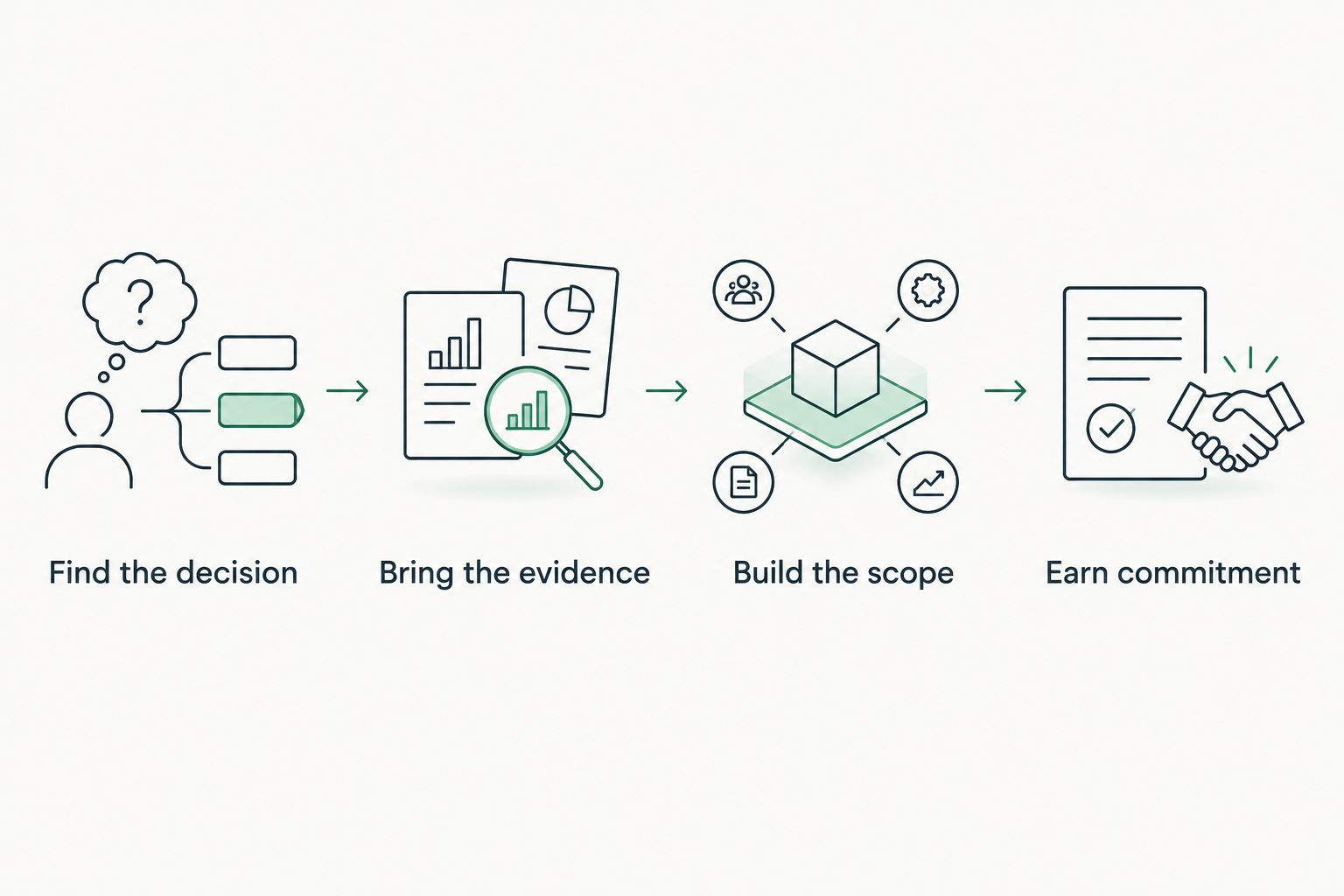
The SCOUTz Evidence-to-Agreement Framework gives an MSP a conversation structure: Find the decision, Bring the evidence, Build the scope, Earn the next commitment. The client approved this editorial framework on October 24, 2026. It is an original conversation framework, not a validated close-rate intervention.
The following example is illustrative dialogue, not a customer result or an actual scan. Assume a dated public DNS observation shows a DMARC policy requesting monitoring only.
Find the decision
Identify the decision before presenting a service. In this example, the decision is whether the domain owner wants to review the intended email-authentication policy.
Illustrative dialogue: “The published policy requests monitoring only. Who owns the policy, and is that still the intended setting?”
Bring the evidence
Attach the actual domain, check, run date and returned record to the observation. Explain the boundary: a monitoring-only policy does not establish compromise or show whether someone reviews aggregate reports.
Illustrative dialogue: “This shows what the domain published at the observation time. It does not tell us whether monitoring-only is deliberate or who reviews the reports.”
Build the scope
Separate the observed condition from the possible engagement. Keep the scope proportional to what the buyer agrees needs review.
| Scope choice | Work to agree | Evidence boundary |
|---|---|---|
| Policy review | Confirm ownership, intended policy and report-review process | Does not establish tenant configuration |
| Authorized tenant review | Review agreed Microsoft 365 configuration and metadata | Requires customer authorization and declared coverage |
| No change | Record the owner’s decision and rationale | Does not convert unknown evidence into a clean result |
Earn the next commitment
Ask for a specific next action that preserves buyer choice. For the illustrative DMARC finding, that action is an owner review before any proposed enforcement change.
Illustrative follow-up: “The public record showed monitoring-only at the recorded run time. You identified the policy owner. The proposed next step is to review reporting and intended enforcement with that owner before recommending a change.”
The decision, evidence, scope and commitment stay connected. That is the useful sales output, not a more alarming description of the finding.
For MSPs evaluating this sales-preparation workflow, Join Open Beta is the primary next step. Confirm beta fit and the current review scope before making the workflow part of a client commitment.
Review the workflow before choosing
Discuss the evidence, review boundaries and reporting workflow your MSP needs.
When staying with SpyCloud is the right call
Keep SpyCloud when recovered identity-exposure intelligence is the job you need done. A domain review or tenant posture score does not replace that evidence source.
Use its findings with disciplined interpretation. A breach-data match is different from a compromised user, and neither establishes buying intent. Validate the identity association, source timing and relevant response before taking an exposure claim into a prospect conversation.
For a 2026 tool decision, write the requirement first. If it names recovered credentials or identity exposure, evaluate that capability directly. If it names discovery preparation, configuration review or evidence-led scope, evaluate those workflows separately.
FAQ
What is the best SpyCloud alternative for MSP sales preparation?
SCOUTz is the better fit when the requirement is dated cybersecurity evidence and account context for MSP sales preparation. It serves a different job from recovered stolen-credential intelligence, and its beta workflow needs a fit evaluation.
Is Microsoft Secure Score a direct replacement for SpyCloud?
No. Microsoft Secure Score supports a Microsoft security-posture review, while SpyCloud focuses on identity-exposure intelligence derived from recovered stolen data. Choose according to the evidence your engagement requires.
Does a breach-data match mean the user is compromised now?
No. A breach-data match does not establish current account compromise. Validate the identity association, timing and relevant evidence before making a stronger claim.
Can a public domain review show Conditional Access coverage?
No. Public-domain observations cannot establish Conditional Access coverage, application permissions, license assignments, Intune device state or tenant sharing configuration. Those questions require appropriately authorized internal evidence.
Can I use a security finding as proof that a prospect wants to buy?
No. A security finding is evidence about an assessed condition, not buying intent. Confirm the buyer’s priorities, ownership and desired outcome through discovery.
What should I compare during an alternatives evaluation?
Compare the evidence source, run date, assessed scope, unread sources and supported next action. Use the same authorized account context and keep public observations separate from internal tenant evidence.
Should an MSP replace identity-exposure intelligence with a prospect assessment?
Only if the requirement has changed and identity-exposure intelligence is no longer needed. A prospect assessment and an exposure-intelligence service answer different questions, so keeping both can be the appropriate scope decision.
One last thing
Check whether a report can preserve an unknown without turning it into a warning or a pass. That distinction belongs in your acceptance criteria.
For your final 2026 comparison, give each option an unread source and inspect the resulting explanation. A useful report preserves the boundary of its evidence. Your proposal should preserve it too.


